Detect Insurance Fraud Quickly with AI & ML Tech
Insurance fraud is one of the biggest challenges faced by the global insurance industry today. From fake accident claims to inflated medical bills, fraud not only causes financial losses but also increases premiums for honest customers. Traditional fraud detection methods are no longer sufficient to deal with modern, sophisticated fraud schemes.
This is where Artificial Intelligence (AI) and Machine Learning (ML) come into play. Companies like MGNIT LTD are leveraging advanced AI-driven solutions to help insurers detect fraudulent claims faster, smarter, and more efficiently.
Why Fraud Detection in Insurance Claims Is So Hard
Detecting fraud in insurance claims is not as simple as identifying incorrect information. There are several reasons why it is particularly challenging:
1. Complex and Evolving Fraud Techniques
Fraudsters continuously change their tactics. From staged accidents to fake documentation and identity theft, fraud is becoming more advanced with technology. Even generative AI is now being used to create fake evidence like images and documents, making detection harder.
2. Huge Volume of Data
Insurance companies process thousands of claims daily. Each claim includes structured data (policy details, claim amount) and unstructured data (images, reports, emails). Analyzing all of this manually is nearly impossible.
3. Hidden Fraud Patterns
Fraud is often not obvious. Organized fraud rings involve multiple people, locations, and transactions that appear unrelated. Traditional systems struggle to detect these hidden connections.
4. High False Positives
Older rule-based systems often flag legitimate claims as fraud, leading to delays and poor customer experience. In fact, legacy systems can generate up to 80–90% false positives.
5. Limited Human Capacity
Special investigation teams can only review a small percentage of claims. This means many fraudulent claims go undetected.
How AI and ML Solutions Help Find Fraud Faster
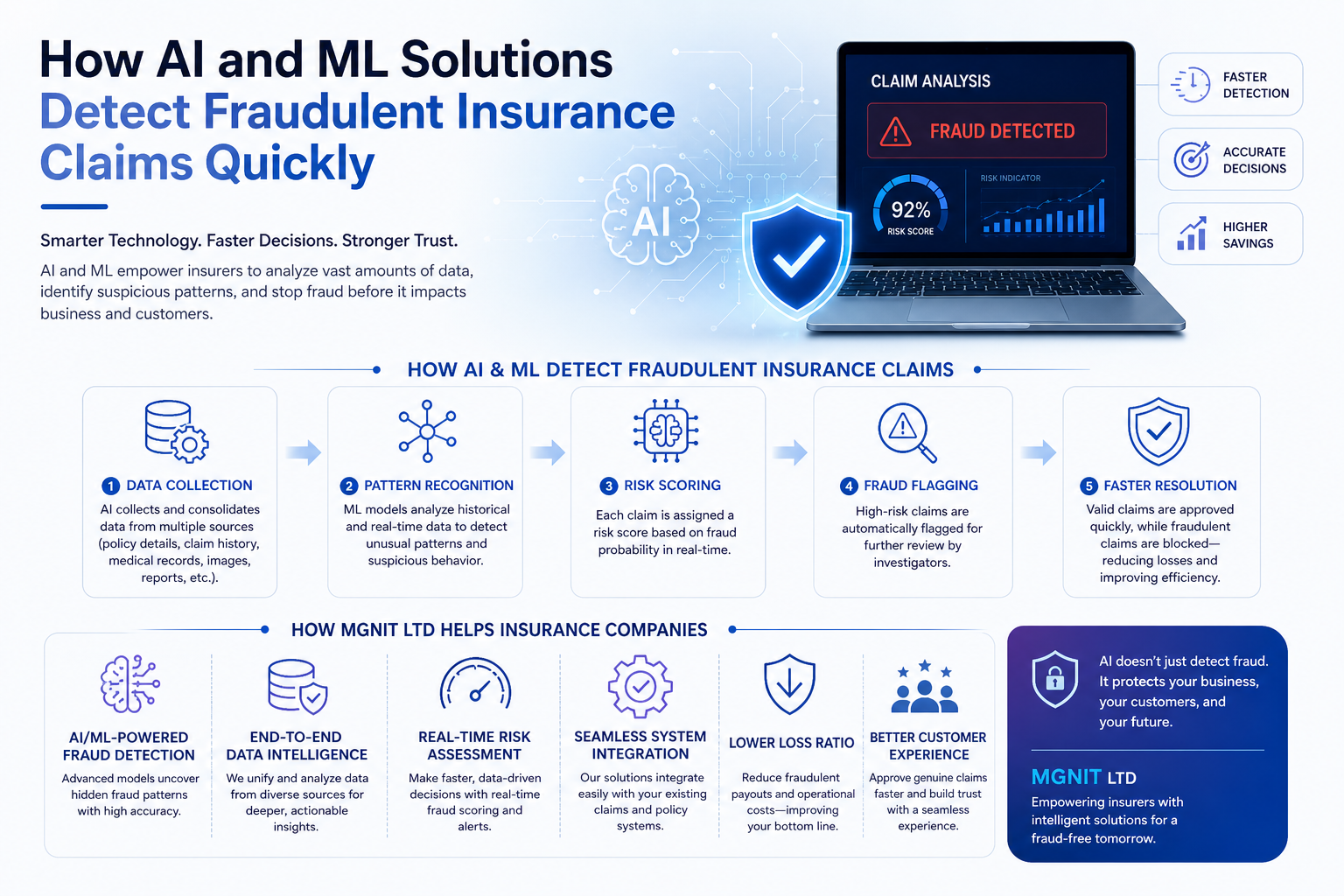
AI and ML technologies are transforming how insurers detect fraud by automating analysis and identifying patterns that humans might miss.
1. Real-Time Data Analysis
AI systems can analyze claims instantly as they are submitted. Instead of waiting days or weeks, insurers can identify suspicious claims within seconds.
Machine learning models process large datasets and detect anomalies—such as unusually high claim amounts or repeated claims from the same user.
2. Pattern Recognition and Anomaly Detection
AI learns from historical data and identifies patterns of both normal and fraudulent behavior.
For example:
- Frequent claims within a short time
- Claims inconsistent with customer history
- Unusual combinations of damages and costs
These anomalies are flagged automatically for further investigation.
3. Predictive Fraud Scoring
ML models assign a fraud risk score to each claim based on multiple parameters. High-risk claims are prioritized for investigation, while low-risk claims are processed quickly.
This improves efficiency and ensures that investigators focus on the most suspicious cases.
4. Network and Relationship Analysis
AI can map relationships between different entities such as claimants, hospitals, repair shops, and agents.
This helps detect organized fraud rings that operate across multiple claims. Graph-based AI models can uncover hidden connections that traditional systems cannot detect.
5. Image and Document Verification
Using computer vision and natural language processing (NLP), AI can:
- Analyze accident photos for tampering
- Detect duplicate images across claims
- Validate medical records and invoices
This significantly reduces fraud involving fake documentation.
6. Automated Claims Triage
AI systems categorize claims based on risk and complexity.
- Simple claims → fast-track approval
- Suspicious claims → detailed investigation
This ensures better resource allocation and faster claim processing.
7. Continuous Learning and Adaptation
Unlike traditional systems, ML models continuously learn from new data. As fraud tactics evolve, AI systems adapt and improve their detection capabilities over time.
Key AI and ML Techniques Used in Fraud Detection
Several advanced technologies power modern fraud detection systems:
- Supervised Learning: Trains models using known fraud cases
- Unsupervised Learning: Identifies new and unknown fraud patterns
- Natural Language Processing (NLP): Analyzes text data like reports and emails
- Computer Vision: Detects fraud in images and videos
- Graph Analytics: Identifies relationships and fraud networks
- Predictive Analytics: Forecasts potential fraud risks
These techniques work together to create a comprehensive fraud detection system.
Benefits of AI-Based Fraud Detection
Implementing AI and ML in insurance fraud detection offers several advantages:
- Faster Detection: Identify fraud in real-time
- Higher Accuracy: Reduce false positives and missed fraud
- Cost Savings: Prevent billions in fraudulent payouts
- Improved Customer Experience: Faster claim approvals for genuine customers
- Scalability: Handle large volumes of claims efficiently
AI-powered systems can detect up to 95% of fraudulent claims and significantly reduce losses for insurers.
How MGNIT LTD Helps Insurance Companies
At MGNIT LTD, we specialize in building intelligent AI and ML solutions tailored for the insurance industry.
Our solutions help insurers:
- Automate fraud detection processes
- Analyze large datasets in real time
- Improve decision-making with predictive insights
- Reduce operational costs and fraud risks
Visit: https://www.mgnit.co.uk/
With the right technology partner, insurance companies can transform their fraud detection systems and stay ahead of evolving threats.
Conclusion
Insurance fraud is a complex and costly problem, but AI and ML are changing the game. By leveraging advanced technologies like pattern recognition, predictive analytics, and network analysis, insurers can detect fraud faster and more accurately than ever before.
As fraudsters become more sophisticated, adopting AI-driven solutions is no longer optional—it is essential. Companies like MGNIT LTD are leading this transformation, helping insurers build smarter, faster, and more secure systems for the future.